




OHP 21st Century Diseases Final Reflection
COVID-19 has left an impact on the world larger than anything else in our lifetime. Many social, political and economic impacts can be seen from this virus, in addition to health related issues becoming a topic of discussion more than ever before.
Socially, COVID-19 is disproportionately impacting minority groups. Minority groups being disproportionately impacted during a pandemic, sadly, is not new to America. During the 1918 Flu Pandemic, Black or African American individuals were also disproportionately impacted. According to a study conducted by Dr. Vanessa Northington Gamble, "when the 1918 influenza epidemic began, African American communities were already beset by many public health, medical, and social problems, including racist theories of black biological inferiority, racial barriers in medicine and public health, and poor health status," the study reads.
Although America has made progress since 1918, disproportionate impact is still evident in the pandemic we are currently facing.
Not only as a journalist but as a person, I find this disproportionality extremely frustrating and upsetting. I reported on this disproportionality for one of my journalism courses earlier this semester. It is extremely upsetting, confusing and greatly saddens me to report these numbers. As a journalist, I work to inform and provide information for all. I just wish those on the receiving end of the information experienced equality, as I work to provide equality for those I have the opportunity to serve as a journalist. As my career continues, I hope there are changes in our healthcare and society that help mend this disproportionality.
Politically, in the United States, each state has seen leadership from its Governor. But, the overarching leadership all Americans have witnessed is that of President Donald Trump. The President signed a number of orders to aid Americans during the pandemic, ranging from preventing hoarding of medical supplies to accelerating economic recovery and providing assistance to renters and homeowners. Some of President Trump's efforts, or lack thereof, were controversial, including the travel ban he announced in March, which prevented those who are not Americans and had been in the Schengen Area within fourteen days of their attempt to enter the United States. Journalists have reported on President Trump's orders and have pointed out things he has or has not done, such as failing to wear a mask at different gatherings or events with his team and others.
Being a journalist, it is hard to think that President Trump has much respect for me as a professional after seeing how he treats most journalists in addition to his constant claims of "fake news". I am not saying the news media is always right or perfect by any means. Personally, I think the media could have reported more on the orders mentioned above and less on the travel ban. But, I do believe that there are good journalists out there who are focused on finding and reporting the truth. I have not been impacted by the political impacts of COVID-19 as a journalist, but I have watched them play out through the media.
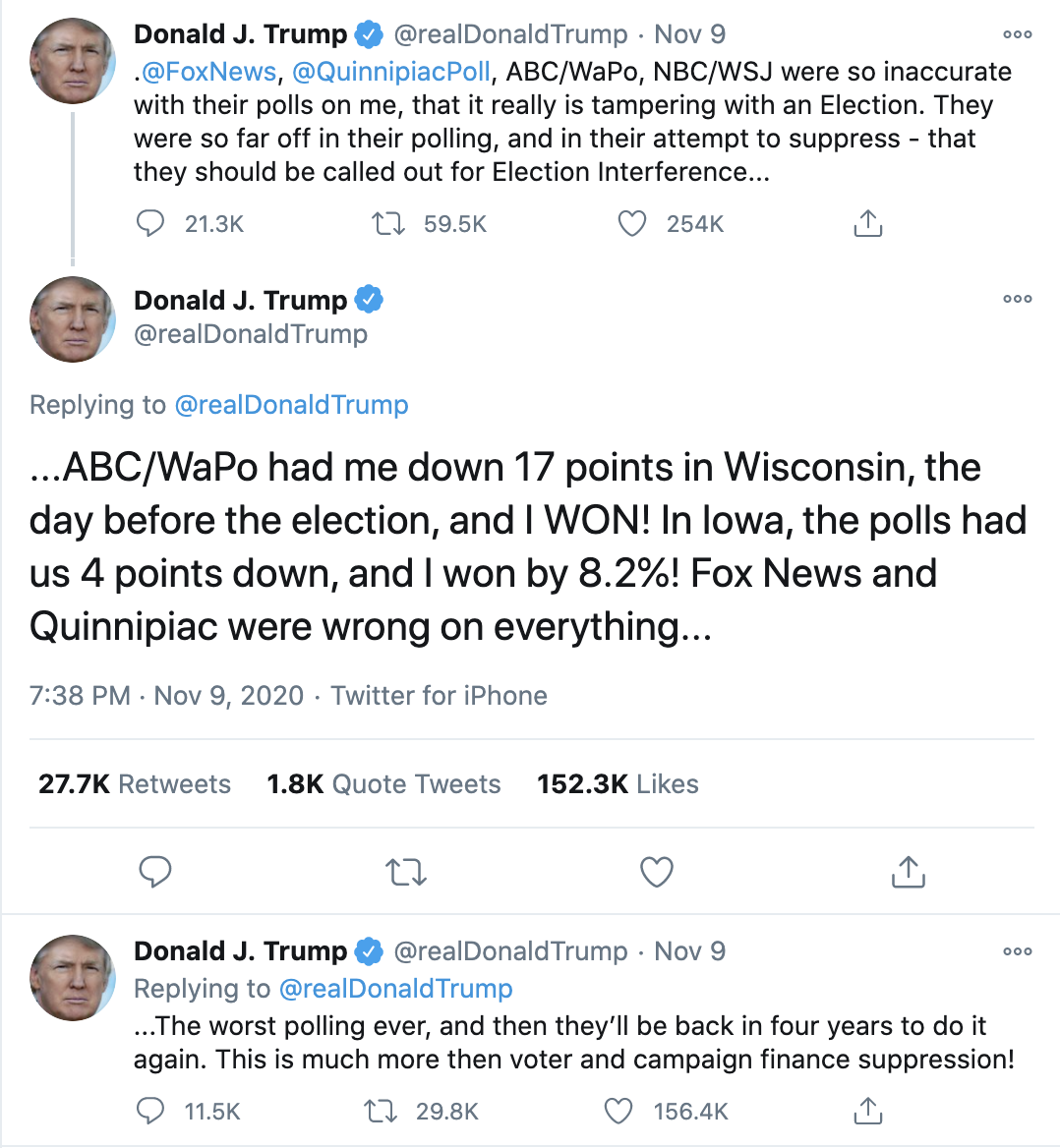
President Trump, who communicates often through Twitter, is quick to call out the media when he does not agree with what they are reporting. But, Trump later retweets posts made by some of these outlets, most of them being Fox News, when the reporting benefits him. It is frustrating as a journalist to watch President Trump say the things he does about the media, but then turn around and share content of the media he just bashed. I find this specifically detrimental to Americans during the COVID-19 pandemic. Americans should be able to tune into a news source they trust to learn more about COVID-19 in their area, remain informed and then use that information to make decisions that are the best for them and their families. By President Trump being so negative regarding the media, I think it can be easy for Americans to lose trust in journalists and the media as a whole and potentially miss out on hearing life saving information or information that would impact the decisions they make for themselves and their families each day.
When it comes to the economy, COVID-19 has left its mark in more ways than one. One area that has been greatly impacted is the business community, and particularly small businesses. In March, Dr. Amy Action, who was the Director of the Ohio Department of Health at the time, ordered all bars and restaurants to close their dining rooms. But, businesses were allowed to offer carry-out and delivery options. Although this order was seen to be necessary in preventing the spread of COVID-19, many businesses and employees were negatively impacted financially by this order.
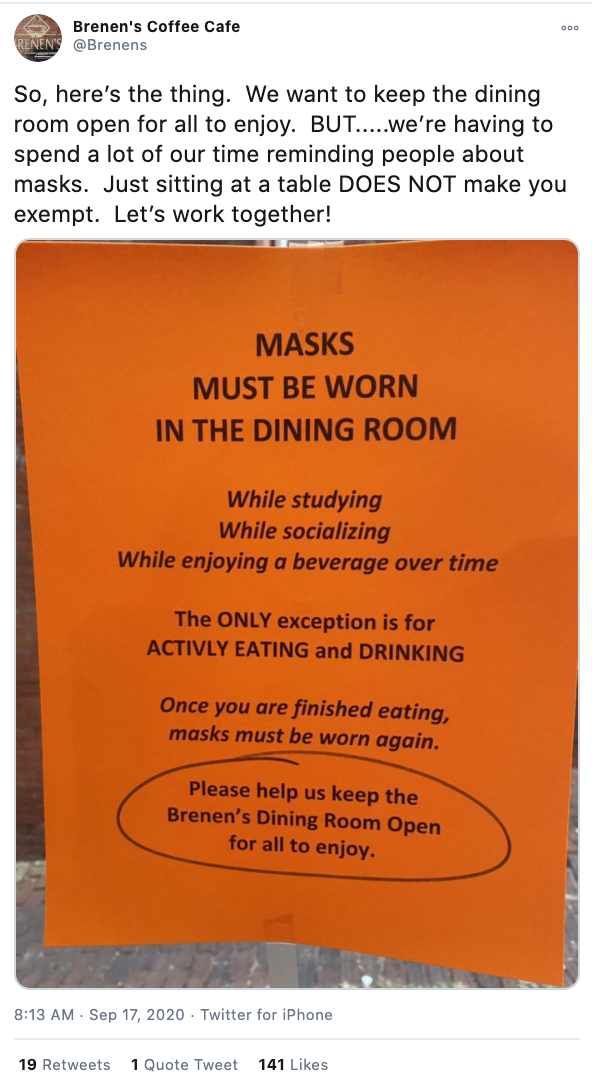
Even once establishments were permitted to open up their dining spaces, mask mandates were, and are, still in effect. Brenen's Coffee Cafe, a local cafe in Athens, was seen asking customers to follow mask mandates while in their cafe in September.
The media has reported a lot on the issue of bars and restaurants closing their dining rooms across the country. Sadly, some of the businesses may never re-open. When sharing these stories as a journalist, it can be difficult to remove your own feelings or beliefs from the story. Although it may have been necessary for these businesses to close for the health and safety of their communities, it is hard to talk to a business owner who is watching everything they have worked and dreamed for slip away from them due to a virus that is totally out of their control. For me, this is an example of when unbiased reporting comes into play. Despite what I may think about the situation, it is my job, and the job of journalists, to tell the story from an unbiased point of view. Journalists provide the facts, which allows those taking in the information to make their own decisions and have their own thoughts about the topic at hand. If a story is told well, people should be able to walk away from the broadcast or story with varying opinions, like with anything else. As long as communities are provided with the facts and only the facts, journalists are doing the job properly.
COVID-19 has also impacted the health of people all around the world in many ways. One important aspect of this pandemic is those who are considered high risk. Although some people may fight COVID-19 better than others, situations and even where one lives can put individuals at higher risk of contracting COVID-19. For those who are high risk, this can pose a threat to their health.
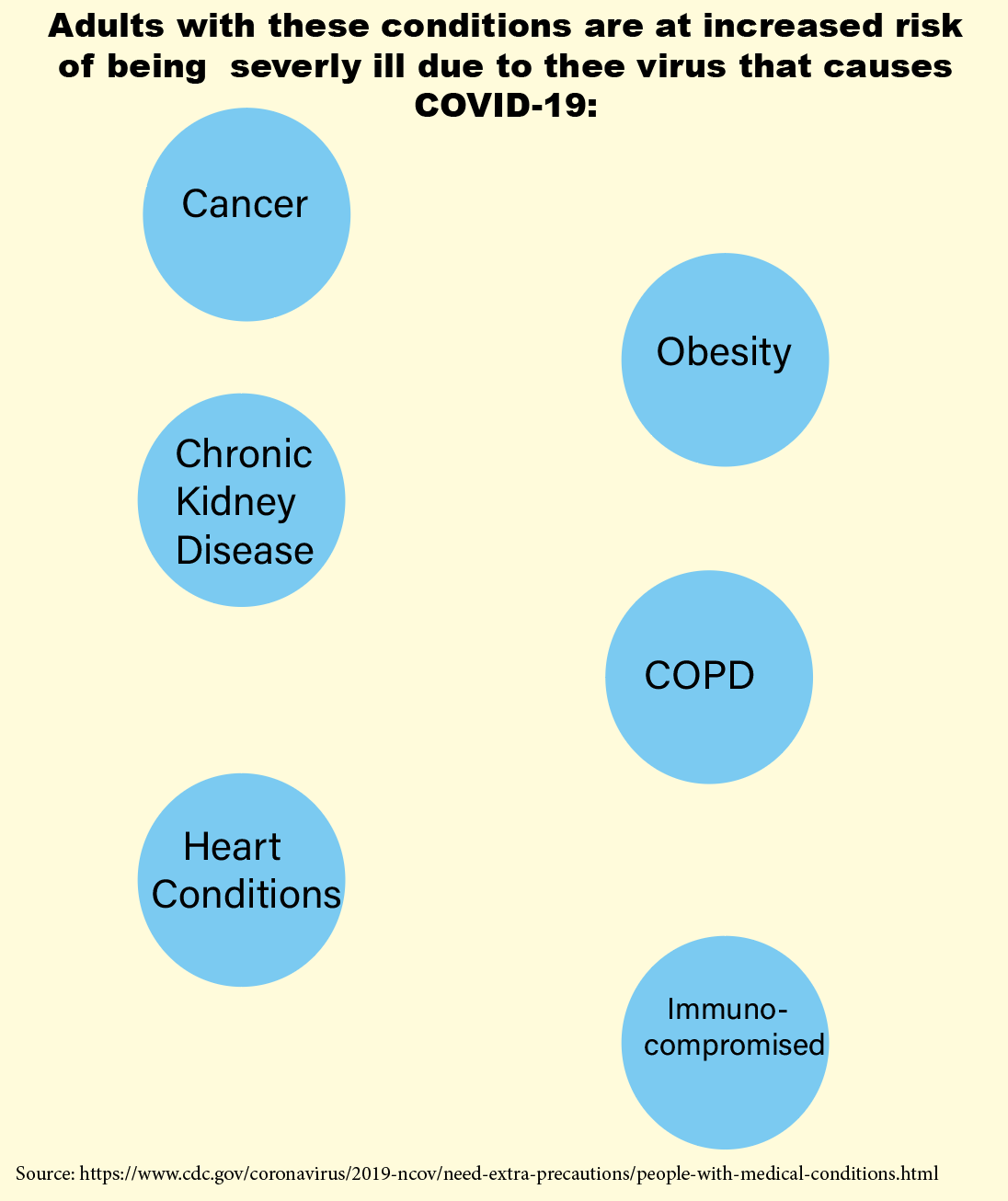
From the perspective of a journalist, I think it is important to remember that journalists are not doctors or medical professionals. Journalists are reporting information provided to them about COVID-19, but most likely have limited knowledge on the topic. I think it is important, especially if you are high risk, to always do your own research and understand the situation you are in. The information one learns from the media could be used to start a conversation with their doctor, but the information learned should not be used for a self-diagnosis of any kind. The majority of journalists can be trusted to report accurate information, but at the end of the day, the information they are relaying is not, and should not be taken as, medical advice.
All in all, COVID-19 is undeniably impacting and changing our world as we know it. Like many professions, journalists are facing difficulties each day. It can be draining to report on the difficult position our nation and world is in with COVID-19 and how some specific communities are being impacted more by this virus than others. It is also hard reporting on this topic in the era of "fake news" and with a President who is not always fond of the media. Additionally, there is the challenge of reporting on the economy and the small businesses that are getting hit hard by having to close their dining rooms and potentially lose their business. Finally, it can be difficult to report on topics that some journalists may have little knowledge about, such as the reasons why high risk individuals are high risks. Journalists are just that - journalists - and not medical professionals. Now is a trying time for our world, and the field of journalism is not exempt from the difficulties all of us are facing.
Sources: https://www.census.gov/quickfacts/fact/table/US, https://www.cdc.gov/coronavirus/2019-ncov/covid-data/investigations-discovery/hospitalization-death-by-race-ethnicity.html, https://www.cdc.gov/coronavirus/2019-ncov/covid-data/investigations-discovery/hospitalization-death-by-race-ethnicity.html, https://www.govinfo.gov/content/pkg/FR-2020-03-26/pdf/2020-06478.pdf, https://www.govinfo.gov/content/pkg/FR-2020-03-26/pdf/2020-06478.pdf, https://www.govinfo.gov/content/pkg/FR-2020-06-09/pdf/2020-12584.pdf, https://www.whitehouse.gov/presidential-actions/proclamation-suspension-entry-immigrants-nonimmigrants-certain-additional-persons-pose-risk-transmitting-2019-novel-coronavirus/, https://www.cdc.gov/coronavirus/2019-ncov/need-extra-precautions/index.html?CDC_AA_refVal=https%3A%2F%2Fwww.cdc.gov%2Fcoronavirus%2F2019-ncov%2Fneed-extra-precautions%2Fpeople-at-increased-risk.html, https://www.cdc.gov/coronavirus/2019-ncov/need-extra-precautions/index.html?CDC_AA_refVal=https%3A%2F%2Fwww.cdc.gov%2Fcoronavirus%2F2019-ncov%2Fneed-extra-precautions%2Fpeople-at-increased-risk.html
